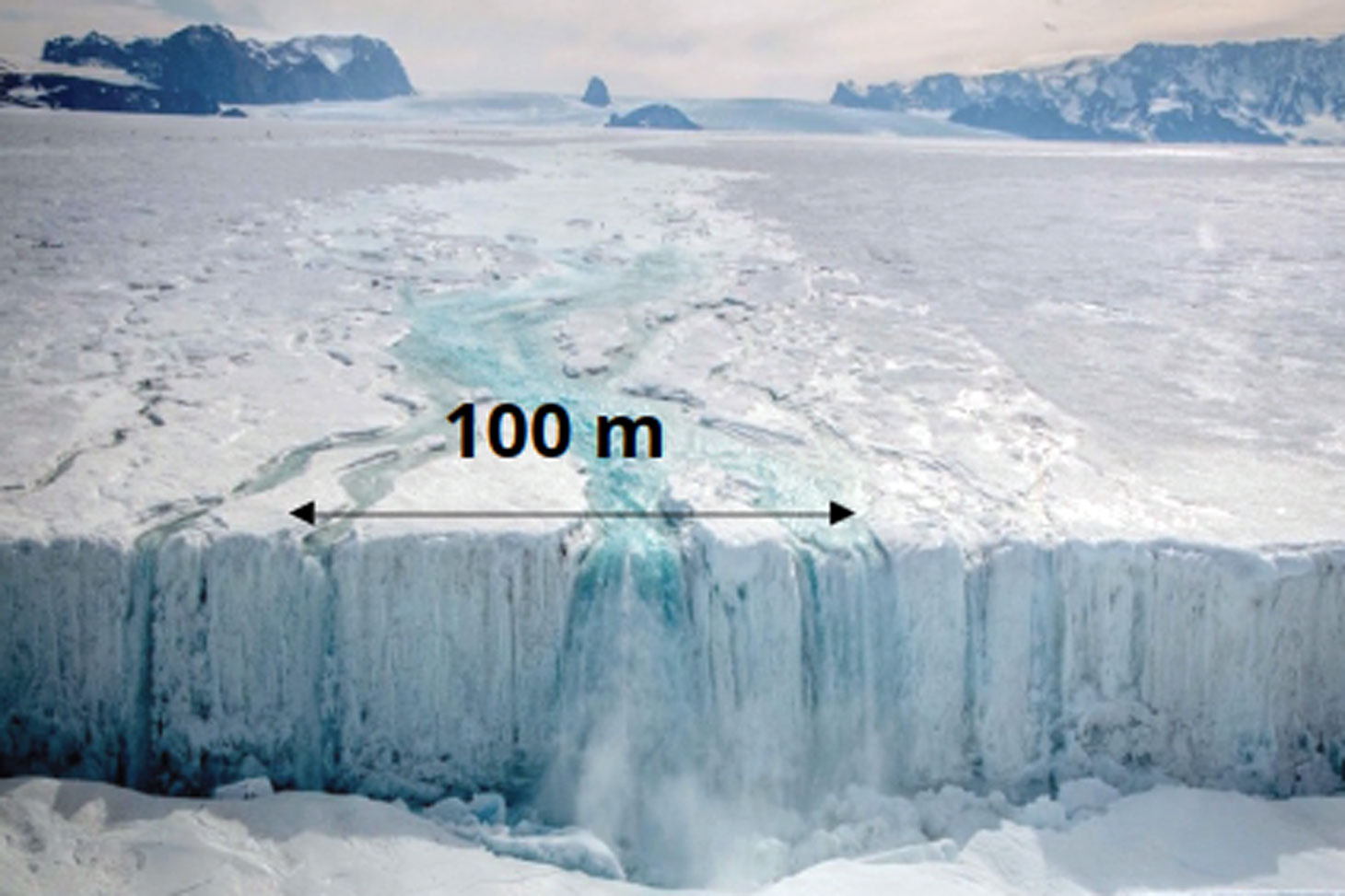
The melting of the polar ice caps in Greenland and Antarctica will play a major role in sea-level rise. The scientific community is attempting to predict how they will evolve in a changing climate. One of the key parameters in these models is meltwater.
Meltwater contributes to rising sea levels both directly, through runoff, and indirectly, by destabilizing and fracturing the polar ice cap. As part of his dissertation, Glenn Pitiot of the Institute of Environmental Geosciences (IGE) is studying the origin of this meltwater and its interaction with snow.
Observation at the Col du Lautaret
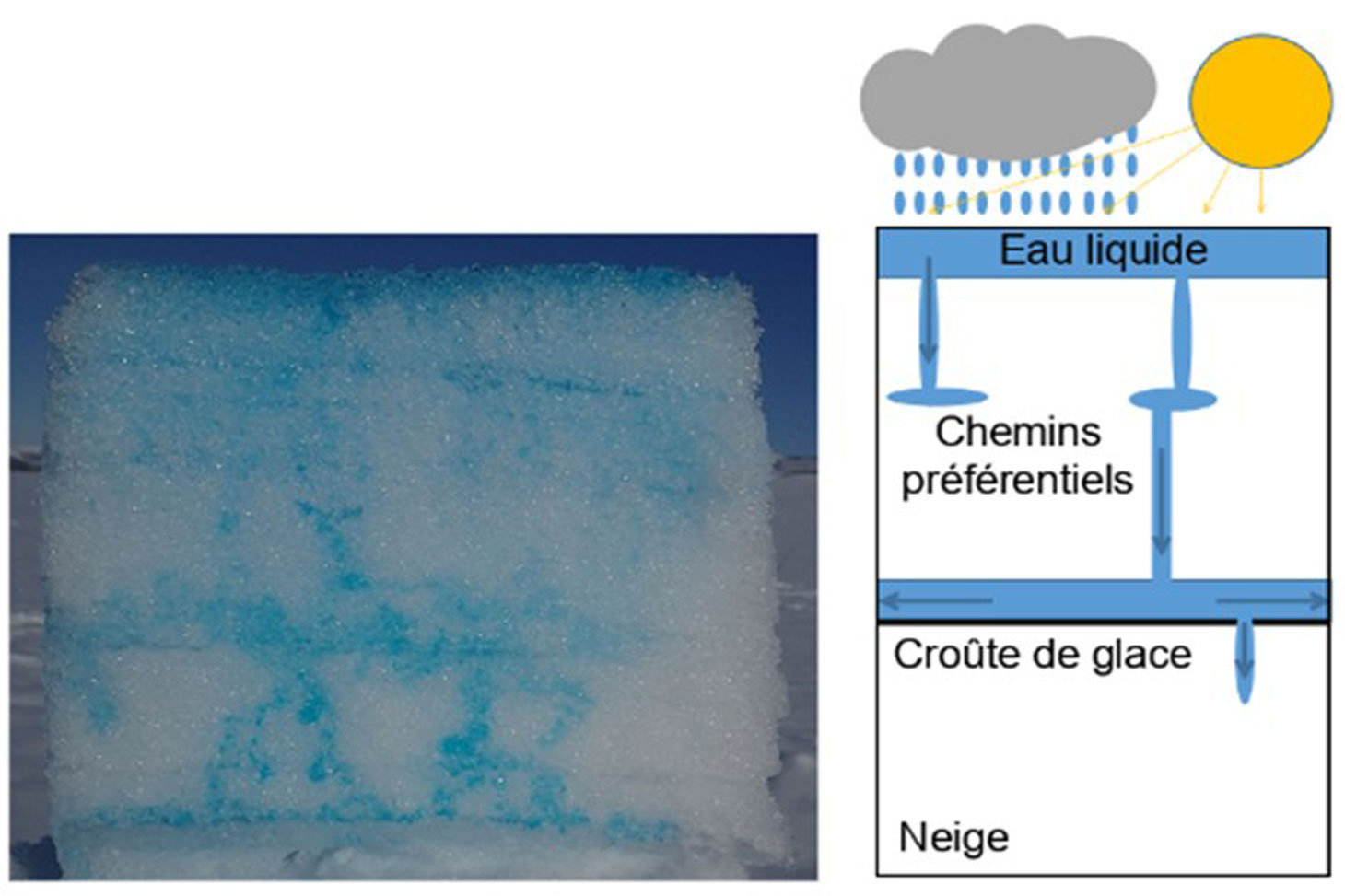
Good modeling, like a good recipe, depends first and foremost on good ingredients. The first step is therefore to identify them, and the Col du Lautaret provides an ideal testing ground for this. This winter, scientists from the IGE simulated the melting of the snowpack using dyes, which allowed them to understand how water flows through the snowpack. From the surface down to the base of the snowpack, water follows preferred paths and accumulates in certain areas. As it refreezes, the water forms layers of ice that in turn affect the flow. The goal was therefore to identify what was blocking the water at these different levels. To do this, the evolution of the mantle—from a dry state to a wet state—was monitored by tracing the origin of these ice layers.
On the left, colored water seeping through the snow, highlighting the role of ice crusts. On the right, a schematic representation of water flow through the snow
Continued work at the North Pole and in the laboratory
An alpine snowpack, due to its thickness and the weather conditions it encounters, is very different from a polar snowpack. Building on their findings and the experiments conducted with the support of the Jardin at the Col du Lautaret, the researchers will spend the entire month of May in Spitsbergen, at Ny-Ålesund (79° North), with the goal of understanding the interaction between meltwater and a polar snowpack.
These two measurement campaigns will contribute to a “catalog” of phenomena that influence water flow within the snowpack. Next year, the IGE team plans to replicate these phenomena in the laboratory while controlling the key parameters. This will then enable them to develop calculation rules (parameterizations) that will be implemented in Météo-France’s Crocus snow model.
Ultimately, our work—from observations at the Col du Lautaret, through laboratory experiments in a cold chamber, to implementation in a numerical model—will enable us to better understand the mass loss of the Greenland and Antarctic ice sheets.
Share the linkCopyCopiedClose modal windowShare this page's URLI recommend this page:Available at this address:The page will then be accessible from your "My Favorites" menu.Stop the videoPlay the videoMutePlay soundChat: Any questions?Chatbot Robo FabricaMatomo traffic statisticsX (formerly Twitter)

 Discovery and science