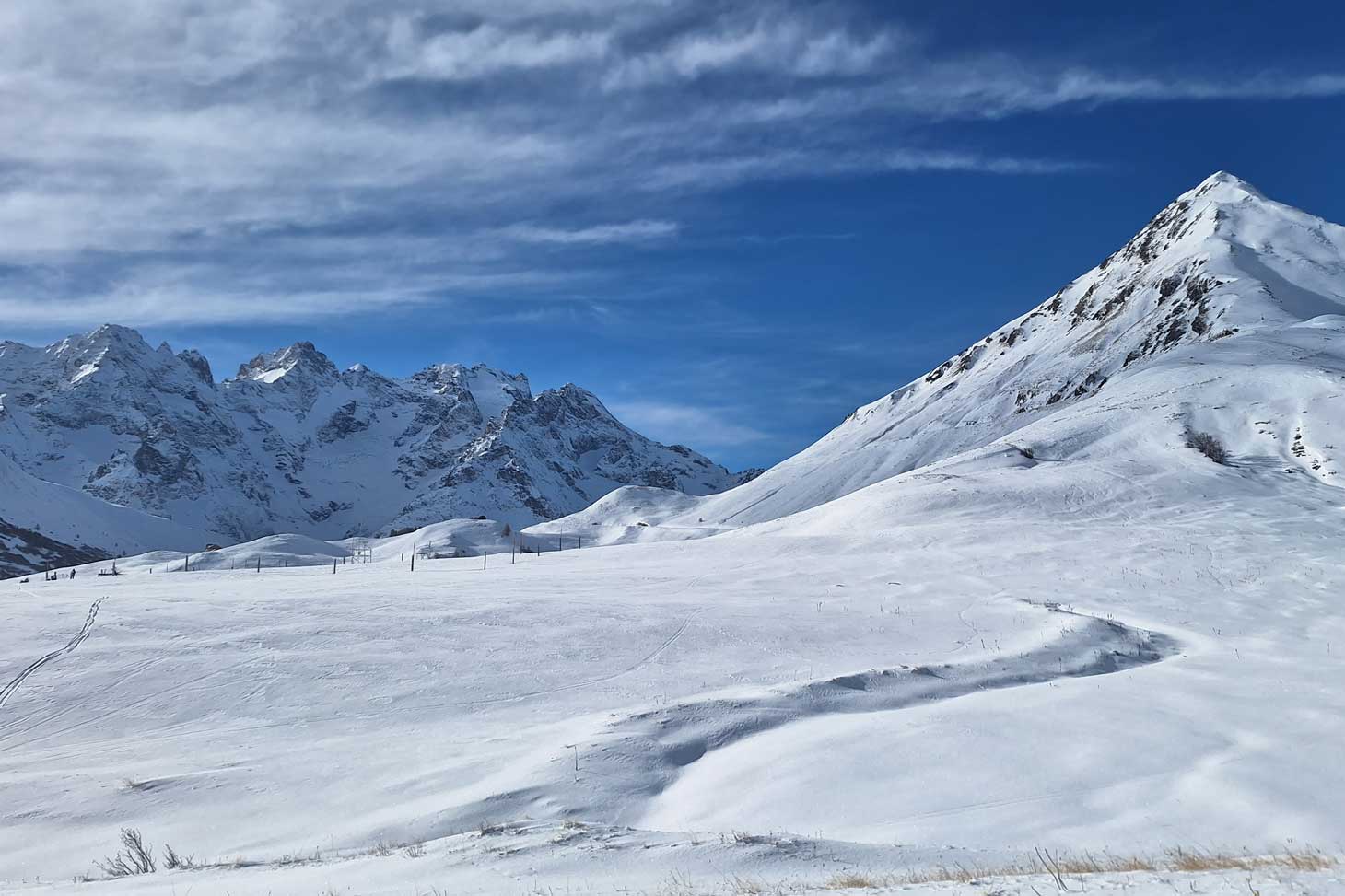
Studying the snowpack is essential! In winter, it significantly alters the properties of the Earth’s surface: it insulates the ground, changes the color of the landscape, and stores water... All of these characteristics influence the climate, water resources, ecosystems... and humans.
Improving our understanding of the snowpack allows us to anticipate future changes resulting from reduced snowfall due to climate warming in the Alps. In this context, one of the main concerns regarding Alpine ecosystems and communities is understanding how changing snow conditions will affect water availability in watersheds that, until now, have relied heavily on snowmelt. The CryHyAlps project aims to address this challenge and better understand the contributions of the snowpack to stream flow in the mountain headwater catchments in the French Alps. The thesis by Elise Navarre, a doctoral student at the Institute of Environmental Geosciences (IGE) supervised by researchers Delphine Six and Giulia Mazzotti, is part of this project funded by INRAE.
Snowpack "mapping" campaigns
Understanding the amount of water stored in the snowpack requires, in particular, studying the amount of snow that has fallen during the winter and accumulated on the ground at different locations and times throughout the winter. Various processes, such as wind transport and terrain shading, make the snowpack highly variable across the landscape. This is why measurements from a single weather station are insufficient to obtain a complete picture of the water resources stored across an entire watershed.
The first phase of the project aimed to collect observational data on the snowpack throughout the winter in the vallon de Roche Noire, one of the study sites at the Lautaret Observatory. The scientists conducted six field campaigns, each involving between four and seven people, to collect optical images captured by a small drone and measure snow density.
Drone flights, covering as large an area as possible, are conducted by a team of two drone pilots from the IGE drone platform. The images can then be stitched together and converted into a 3D model of the snow-covered terrain. The research team will return this summer to repeat the same flights. By comparing the snow-covered terrain models with those of the snow-free terrain, they will be able to generate maps of snow depth at the time of the winter missions.
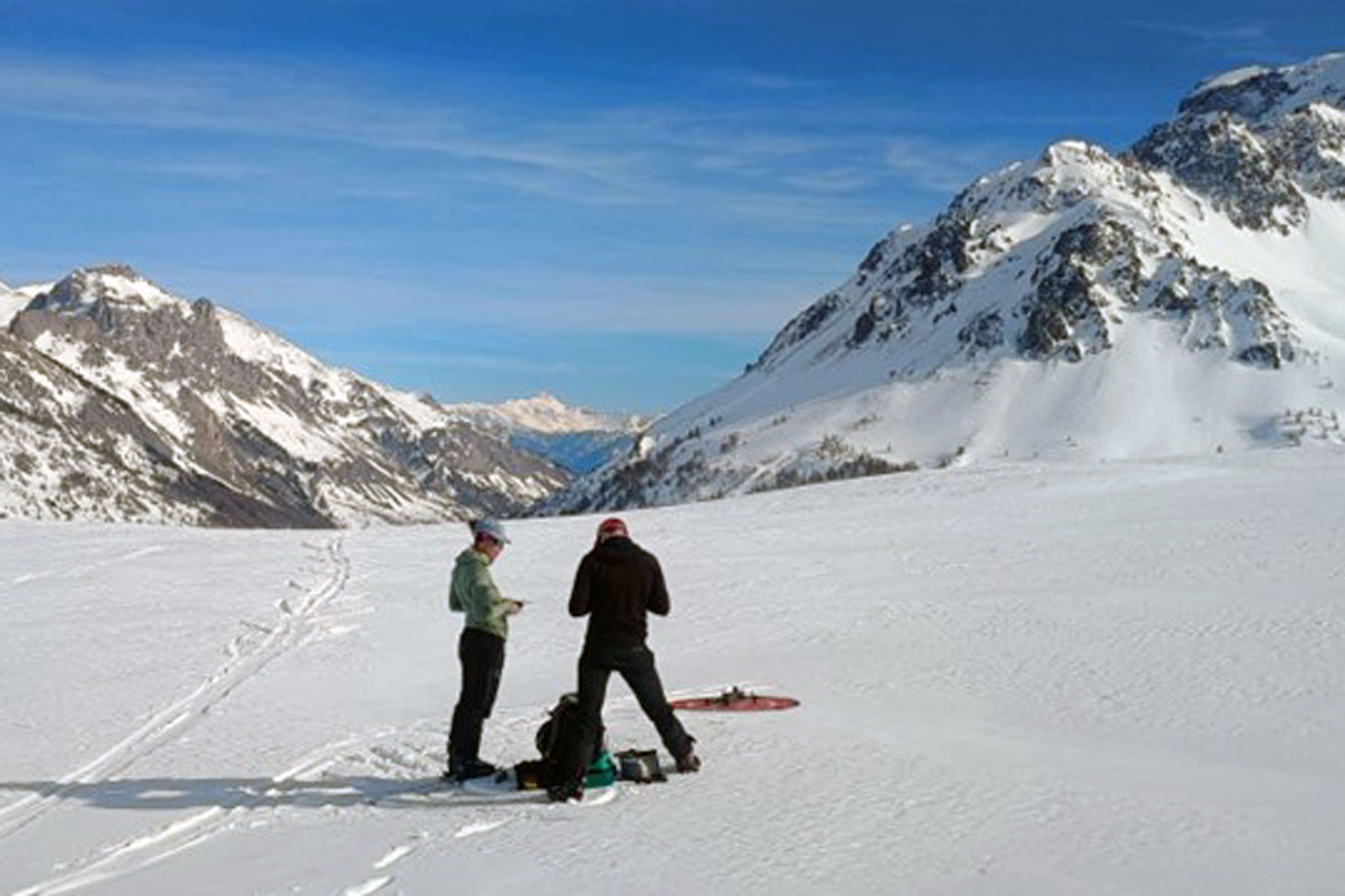
Drone pilots Mylène Bonnefoy-Demongeot and Alexis Buffet are preparing the drone for its flight.
Drone photogrammetry requires that images be accurately georeferenced. To do this, another team is responsible for placing optical targets on the ground in the areas being flown over and recording their positions using differential GPS. At the same locations, the team measures snow density using a snow tube, which snow sampled, measured, and then weighed. Snow density data is essential for converting snow depth—measured by the drone—into water equivalent, i.e., the amount of water stored in the snowpack. Snow density varies much less from one location to another than snow depth, which explains why only a few measurements per mission are sufficient. However, density varies considerably over the course of a season.
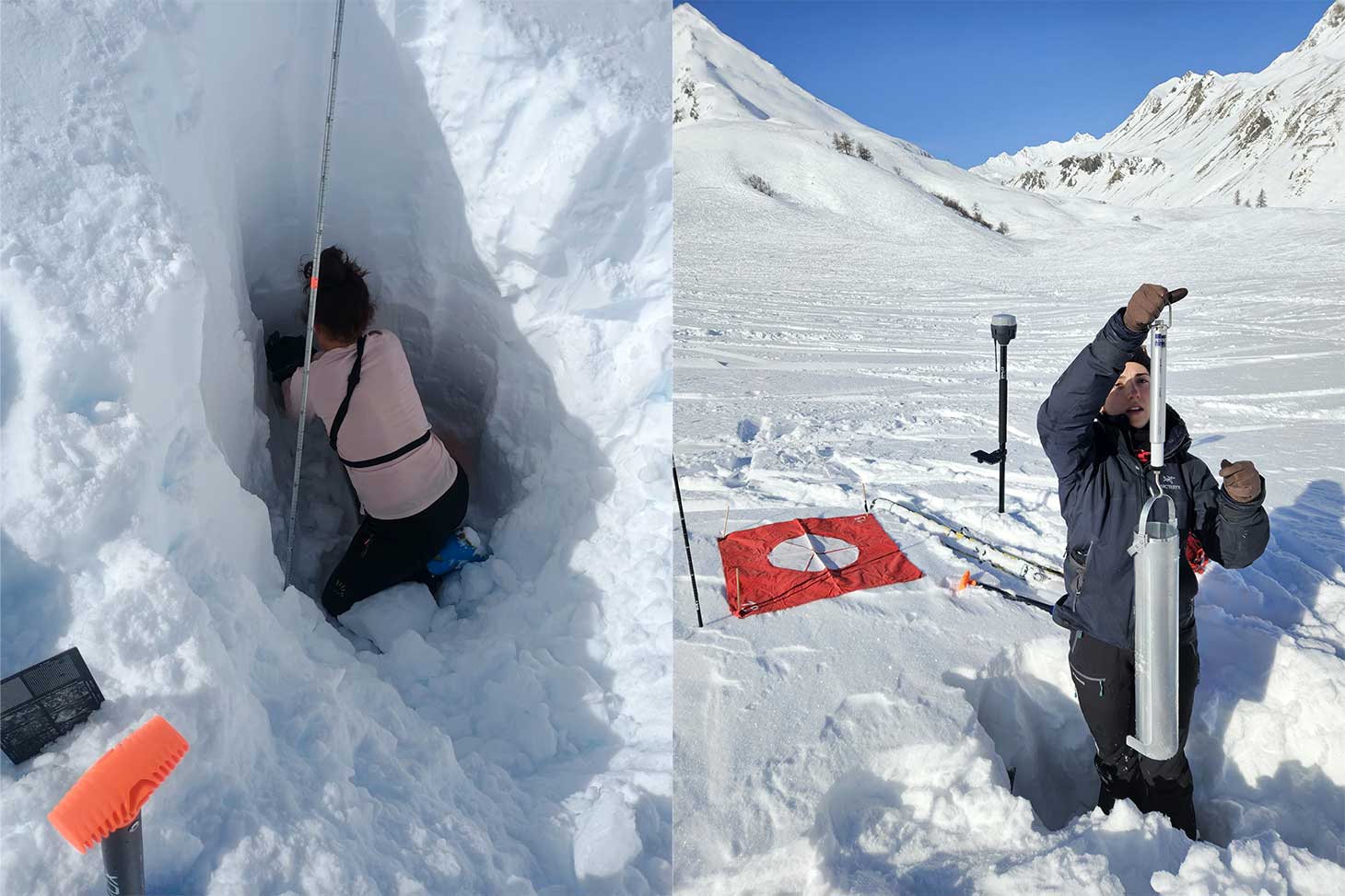
Measuring the water equivalent of the snowpack. Giulia, on the left, is taking a snow core from the bottom of a shaft nearly two meters deep, while Elise, on the right, weighs it immediately. In the image on the right, you can also see one of the optical targets and the GPS antenna, used to record their position.
Linking field data to numerical models
These observations are then used, as a reference for calibrating numerical models that simulate changes in the snowpack. These models are essential for scientists to quantify the condition of the snowpack in areas where no observations are available, or to predict its future evolution. The amount of snow on the ground and its properties, such as density or temperature, vary depending on weather conditions. Field data are therefore primarily used to test the model and identify areas for improvement.
The vallon de Roche Noire, an ideal site for this research
In addition to existing snow data, the vallon de Roche Noire site has meteorological data that can be used to force the model with reliable information. Thanks to streamflow data collected at the basin’s outlet by the Jardin du Lautaret team, the IGE team will also be able to study the relationship between snowmelt and river flow.
We were able to make use of the infrastructure at the Jardin du Lautaret and benefit from the assistance of the on-site staff. We are fortunate to work in such a beautiful environment and under such favorable conditions, but days in the field can still be long and labor-intensive. A big thank you to everyone who helped out and contributed to the success of this first season of the CryHyAlps project—we’ll be back next year!
Text and photos: Élise Navarre, Giulia Mazzotti, IGE

 Discovery and science