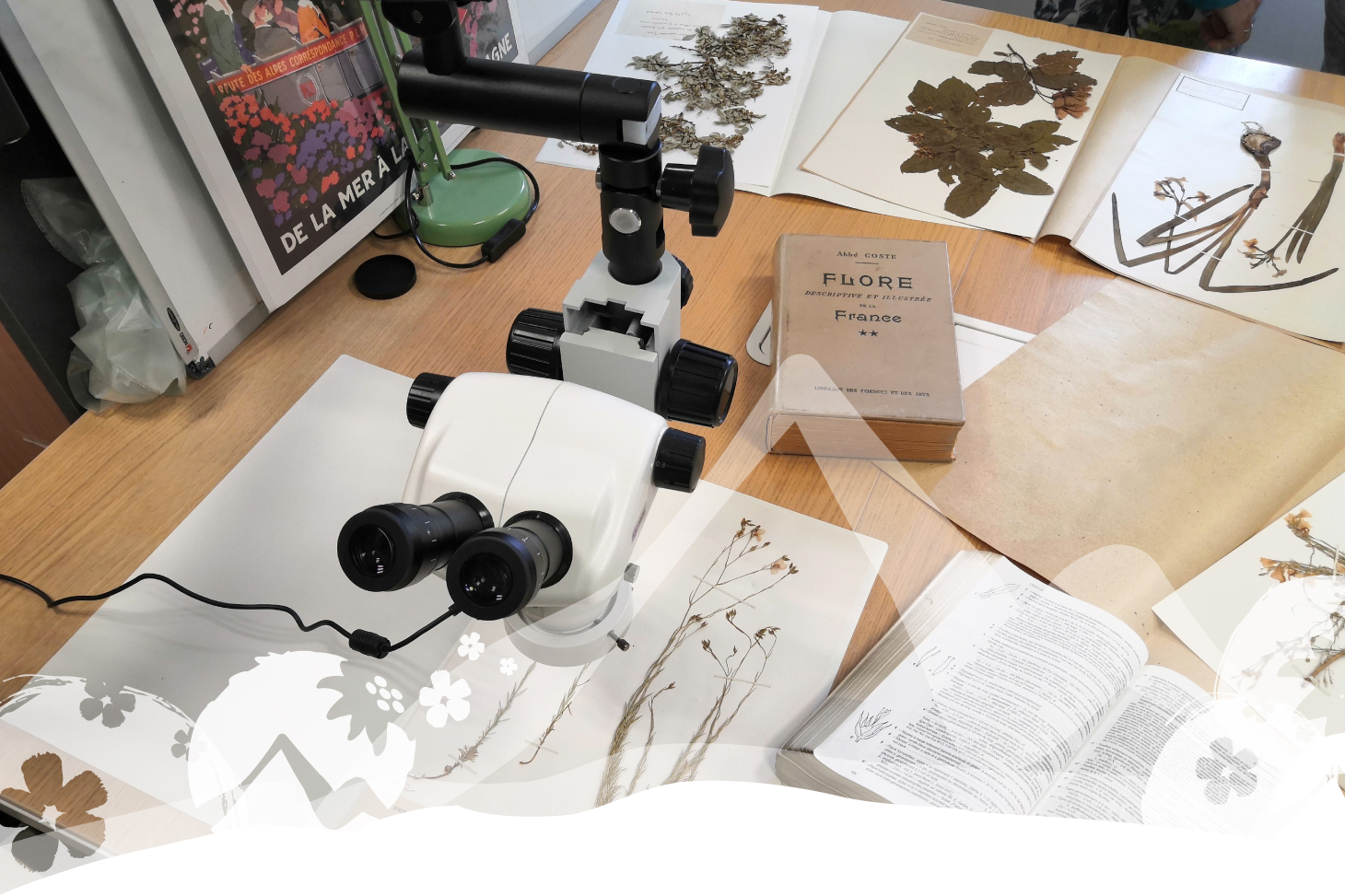
The herbarium ofUniversité Grenoble Alpes UGA), referred to by the acronym GR, was created in 1869. It bears witness to more than 150 years of botanical research in Grenoble, Lautaret, and the sites where the plants in our collection were collected. The jardin du Lautaret has managed The jardin du Lautaret since 2005.
Numerous purchases, exchanges, and donations gradually enriched his collections. These include the herbariums of local botanists such as Adolphe Pellat (1825-1912), the eminent specialist in the Hieracium genus, Casimir Arvet-Touvet (1841-1913), Abbé Louis Célestin Ravaud (1822-1898), Lucie Kopfer (1910-2004), Paul Ozenda (1920-2019), Juliette Asta, Robert Ruffier-Lanche (1912-1973), etc.
The restructuring of the UGA's biology buildings and the development of new areas of research led, in the 1990s and 2000s, the donation of a large part of the collections to the Natural History Museum of Grenoble (acronym MNHGr), the University of Montpellier (MPU), the National Alpine Botanical Conservatory of Gap-Charance (GAP), and the Botanical Gardens and Conservatory of the City of Geneva (G).
Launched in early 2021, the GRenove project aims to reorganize the UGA herbarium to make it easier to consult (family, genus, species) and to digitize it. Several collections have been identified and inventoried:
Ozenda Herbarium
Paul Ozenda was a specialist in the vegetation of the Sahara and the Alps. He directed scientific research activities at the Lautaret Garden between 1954 and 1983. A large part of his herbarium was transferred to the botanical garden and conservatory in Geneva (the North Africa collection). The jardin du Lautaret kept his herbarium collected in the Alpes-Maritimes.
PhyloAlps Herbarium
The PhyloAlps herbarium is the reference herbarium for the project of the same name (see: www.phyloalps.org). The jardin du Lautaret associated with the Alpine Ecology Laboratory in Grenoble as part of this project. This research work, which began in 2009, is a major project aimed at understanding the entire flora of the Alps. Its goal is to gain a better understanding of the evolutionary history of this flora, which is considered to be the most diverse in Europe. In particular, researchers have compiled chloroplast DNA sequences from more than 4,000 species (95% of the species in the Alpine arc). Along with these biological samples, a reference herbarium sample was systematically collected. In total, the PhyloAlps herbarium consists of 5,025 specimens mounted and classified with a barcode and is stored at the Lautaret Garden on the Grenoble campus.
The Lautaret Lichen Herbarium
As part of the activities of the Lautaret Alpine Station (Col du Lautaret, Hautes-Alpes), Lucie Kofler and Prof. Paul Ozenda invited Georges Clauzade (1914-2002) and Yves Rondon to spend a fortnight there for three consecutive years: 1955, 1956, and 1957. In August 1957, Dr. Josef Poelt (1924-1995) and Prof. Carlos das Neves Tavares (1914-1972) accompanied them. They mainly explored the area around the Col du Lautaret (2,058 m) and the Col du Galibier (2,642 m) in order to study the lichens of the alpine zone. These surveys were published in a paper (Clauzade & Rondon, 1959). They collected a collection of nearly 450 samples, which were deposited at the Lautaret Alpine Station (now Jardin du Lautaret).
Left virtually abandoned for some forty years, a decision was made in 2011 to restore this collection. Ms. Juliette Asta undertook a review of all the samples in 2011 and 2012, correcting and updating the scientific names. This collection was the subject of a publication in 2019: Alpine lichens: restoration and study of the collection at the Joseph Fourier Alpine Station (Université Grenoble Alpes, France) by Juliette Asta, Christophe Perrier, and Natacha Claret (Monthly Bulletin of the Linnean Society of Lyon).
The Robert Ruffier-Lanche Herbarium
Robert Ruffier-Lanche (1912-1973) was the head gardener at the Lautaret Alpine Botanical Garden between 1950 and 1973. His passion for botany led him to collect plants in the Lautaret and Pralognan areas.
In 1969, Ruffier-Lanche described the Lautaret herbarium as follows: "A classic herbarium, yet indispensable; a small collection prepared by our predecessors fit on a shelf; the shelf remained, but the sheets were used by the various occupants of the chalet between 1944 and 1950 to light the fire. After 1950, fairly large cabinets were installed in the large laboratory to hold the 70 or so boxes of plants collected and identified, mainly by me. But as the collections of living plants grew considerably and took up all my available time, I had to stop looking after this herbarium; I hope that someone will one day be able to complete it. A herbarium of plants introduced into cultivation would have been very valuable; wanting to include seed samples of the introduced species, I had set aside part of each batch of the original seeds, when the total quantity was sufficient: I sometimes receive packets containing only one or two seeds! But, in addition to the lack of time, the lack of sufficiently large premises prevented me from creating this herbarium of cultivated species.
The data on plant distribution contained therein, which provides unique insight into the flora of Lautaret in the 1950s and 1960s, deserves to be exploited, and the herbarium preserved. In addition, the data collected will undoubtedly be of interest to Jardin du Lautaret partner institutions, such as the National Alpine Botanical Conservatory in Gap and the Ecrins National Park.
The Lautaret Herbarium
Partially collected by Rolland Douzet, this herbarium contains plants from the Col du Lautaret area in the municipalities of La Grave, Villar d'Arène, and Monêtier-les-Bains, and is linked to a book currently being written.
Published on January 27, 2023 Updated on May 6, 2025
Share the linkCopyCopiedClose modal windowShare this page's URLI recommend this page:Available at this address:The page will then be accessible from your "My Favorites" menu.Stop the videoPlay the videoMutePlay soundChat: Any questions?Chatbot Robo FabricaMatomo traffic statisticsX (formerly Twitter)

 Discovery and science